
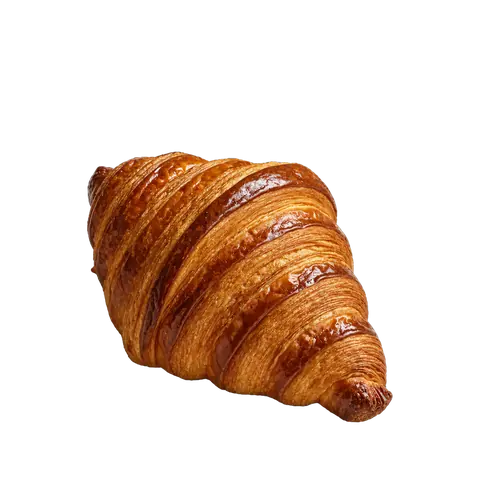
Croissant
A milk-based laminated dough with a little fermented dough in the mix. It takes one book fold and one letter fold, and the shaped croissants proof for a long 2½ hours at 26 °C (80 °F).
- Makes
- 10 pieces
- Total
- 801 g
- Butter
- 70% of the flour
- Layers
- 12 of butter, on paper
The layers
Croissant dough is laminated: a sheet of dry butter is sealed into a yeasted dough, then rolled and folded until butter and dough lie in thin, alternating layers.
The yeasted dough is rolled to 24 × 20 cm and chilled, the dry butter to 12 × 20 cm. They should bend alike when they meet: butter that is too cold cracks, butter that is too warm smears into the dough.
The butter goes on one half of the dough and the other half folds over it. One layer of butter between two of dough.
Rolled out long, both ends fold in to the middle, then the dough closes like a book. Four layers of butter.
Rolled out again and folded in thirds, like a letter: 12 layers of butter between 13 of dough. Then an hour in the refrigerator, so the dough relaxes and the butter firms up.
Rolled to 30 × 45 cm and 3 mm thick, each layer of butter is about 0.05 mm thick on paper. Then the dough is cut and shaped.
The water in the dough and the butter turns to steam and pushes the layers apart, while the butter keeps them from sticking together as they set. That is the honeycomb you see inside.
Why two butters
- Butter in the USAt least 80% fat by law, about 17% water
- Butter in the doughFrench butter: 82% fat, about 16% water. 60 g here
- Dry butter for the layersAbout 84% fat, 14% water. 150 g here
Dry butter (beurre sec) has less water. It stays firm yet pliable when cold, so it rolls into one thin sheet instead of cracking or smearing into the dough, and it does not soften the dough it touches. In the US, use a European-style butter at 82% or more, or 84% laminating butter from a bakery supplier.
Fewer or more folds
More folds make more layers, each thinner. Fewer folds leave thicker layers of butter, with more water in each to turn to steam and open the crumb.
Leavened laminated dough
| Ingredient | Grams | Baker’s % |
|---|---|---|
| 150 g | 50% | |
| 150 g | 50% | |
| 6 g | 2% | |
| 45 g | 15% | |
| 15 g | 5% | |
| 145 g | 48% | |
| 30 g | 10% | |
| 60 g | 20% | |
| Total | 601 g |
Butter for laminating
| Ingredient | Grams | % of flour |
|---|---|---|
| 150 g | 50% | |
| Total | 150 g |
Egg wash
| Ingredient | Grams | |
|---|---|---|
| 35 g | ||
| 15 g | ||
| Total | 50 g |
Milk temperature
The base temperature is 52 to 56 °C (190 to 197 °F): flour, room and milk added together.
Method
Mix
- Work to a base temperature of 52 to 56 °C (190 to 197 °F).
- Dissolve the yeast in the milk at that temperature.
- Add both flours, the salt, sugar, fermented dough and the softened butter.
- Mix with the dough hook on low speed for 5 minutes, then on medium speed for 6 to 7 minutes, until the gluten is well developed.
- The dough should come off the mixer at 24 °C (75 °F).
First proof
- To bake the same day, let the dough rest 30 to 45 minutes at room temperature, then chill it quickly before laminating.
- To bake the next day, let it rest 10 minutes at room temperature, then refrigerate it for 12 hours at 4 °C (40 °F).
Laminate
- Roll the dough to a 24 × 20 cm rectangle and chill it.
- Roll the dry butter into a 12 × 20 cm block.
- Enclose the butter in the dough.
- Give the dough one double (book) fold, then one single (letter) fold.
- Refrigerate for 1 hour.
Shape
- Roll the dough to a 30 × 45 cm rectangle, 3 mm thick.
- Cut 10 triangles with a 9 cm base, each 65 to 70 g.
- Roll each triangle up into a croissant.
Second proof
- Proof the croissants for 2½ hours at 26 °C (80 °F).
Bake
- Brush the croissants with the egg wash of egg yolks and milk.
- Bake in a convection oven for 17 minutes at 160 °C (325 °F).
For bakers in the US
- All-purpose flour (T65)
- French type 65 flour; in the US, a strong all-purpose or a bread flour
- Laminating butter (84% fat)
- Laminating or sheet butter, about 84% fat
- Pâte fermentée (old dough)
- Pâte fermentée: dough kept back from an earlier batch
