
Pithiviers
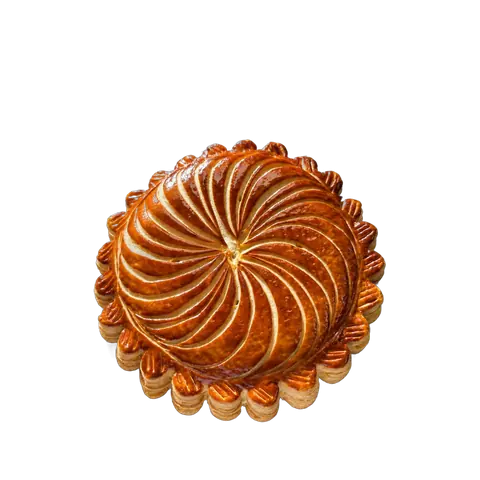
Two squares of puff pastry sealed over a spiral of almond cream, scalloped and scored. The pastry is made inverse, with the butter wrapped around the dough, and rests 12 hours before shaping.
- Makes
- 2 pithiviers (24 cm)
- Total
- 1,856 g
- Butter
- 73% of the flour
- Layers
- 144 of butter, on paper
The layers
Inverse puff pastry turns the usual order around: the butter, kneaded with flour, goes on the outside and the dough on the inside.
The dry butter is kneaded with flour and rolled to 17 × 51 cm, larger than the 17 × 34 cm dough that goes on top of it.
The butter and dough are folded together: a book fold and a letter fold, an hour in the refrigerator, then a book fold and a letter fold again.
That makes 144 layers of dough between 145 of butter. Rolled 3 mm thick, each layer of dough is about 0.01 mm thick on paper.
Steam from the water in the dough and the butter lifts the layers apart, while the butter keeps them separate as they set.
Why two butters
- Butter in the USAt least 80% fat by law, about 17% water
- Butter in the doughFrench butter: 82% fat, about 16% water. 80 g here
- Dry butter, kneaded with flourAbout 84% fat, 14% water. 400 g here
Dry butter (beurre sec) has less water. It stays firm yet pliable when cold, so it rolls into one thin sheet instead of cracking or smearing into the dough, and it does not soften the dough it touches. In the US, use a European-style butter at 82% or more, or 84% laminating butter from a bakery supplier.
Inverse puff pastry: water dough
| Ingredient | Grams | Baker’s % |
|---|---|---|
| 460 g | 100% | |
| 12 g | 2.6% | |
| 80 g | 17% | |
| 200 g | 43% | |
| 4 g | 0.87% | |
| Total | 756 g |
Inverse puff pastry: kneaded butter
| Ingredient | Grams | % of flour |
|---|---|---|
| 400 g | 87% | |
| 100 g | 22% | |
| 100 g | 22% | |
| Total | 600 g |
- For the water dough (détrempe), dissolve the salt and vinegar in the water. Add the flour and softened butter and mix briefly with the dough hook.
- Roll the dough to 17 × 34 cm and chill it.
- For the kneaded butter, mix the dry butter with both flours using the paddle until smooth.
- Roll the kneaded butter to 17 × 51 cm and chill it.
- Lay the dough on the kneaded butter. Give a double (book) fold, then a single (letter) fold.
- Refrigerate for 1 hour.
- Give a second double fold and a second single fold.
- Refrigerate for 12 hours.
Almond cream
| Ingredient | Grams | |
|---|---|---|
| 100 g | ||
| 100 g | ||
| 100 g | ||
| 100 g | ||
| Total | 400 g |
- Mix the softened butter, sugar and almond flour until smooth.
- Add the eggs a little at a time, without overmixing.
- Use the cream right away.
Shaping and baking
| Ingredient | Grams | |
|---|---|---|
| 50 g | ||
| 50 g | ||
| Total | 100 g |
- Roll half the pastry to 3 mm and cut one 24 × 24 cm square for each pithiviers.
- Roll the other half to 2 mm and cut one 24 × 24 cm square for each pithiviers.
- With a 10 mm round tip, pipe a 16 cm spiral of almond cream onto each 3 mm square.
- Lightly moisten the bare edges, lay a 2 mm square on top and press firmly to seal.
- Freeze for a few minutes, then scallop the edges with a piping tip.
- Hold them in the refrigerator.
- Turn each pithiviers over, brush it twice with the egg yolks and score the top.
- Pierce a few small vents (chimneys) in the top with a knife.
- Bake for about 45 minutes at 170 °C (350 °F).
- Brush with the syrup, then return them to the oven for a few minutes to dry.
For bakers in the US
- All-purpose flour (T65)
- French type 65 flour; in the US, an unbleached all-purpose flour
- Laminating butter (84% fat)
- Laminating or sheet butter, about 84% fat
- 60°Bx syrup
- Sugar syrup at 60% sugar by weight (about 3 parts sugar to 2 parts water)
- Chimneys
- Small steam vents cut through the top
- Almond powder
- Blanched almond flour
