
Palmiers
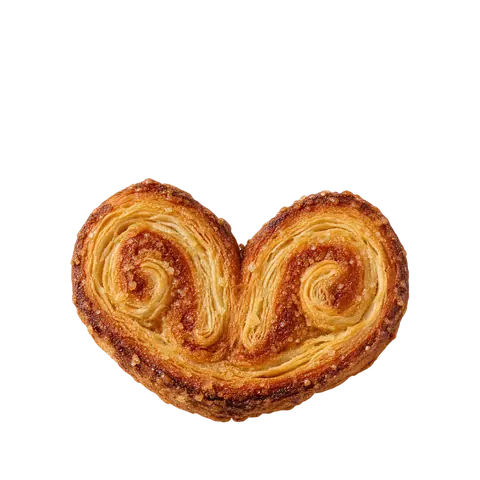
Puff pastry with sugar worked into its last two folds, then folded in from both sides and sliced. The slices spend 15 minutes in the freezer and are turned over halfway through baking.
- Makes
- 10 palmiers
- Total
- 872 g
- Butter
- 76% of the flour
- Layers
- 729 of butter, on paper
The layers
Puff pastry is laminated without yeast: a block of dry butter is sealed into a plain dough, then rolled and folded six times.
A dough of flour, water and a little soft butter is rolled to 30 × 15 cm, the dry butter to a 15 × 15 cm square. They should bend alike when they meet: butter that is too cold cracks, butter that is too warm smears into the dough.
The butter goes on one half of the dough and the other half folds over it. One layer of butter between two of dough.
Rolled out and folded in thirds, two folds at a time with an hour in the refrigerator between: 3, 9, 27, 81, 243 and then 729 layers of butter. The last two folds take the sugar.
Rolled to 60 × 15 cm and 4 mm thick, each layer of butter is about a thousandth of a millimeter thick on paper. Layers that thin break and merge, one reason puff pastry stops at six folds.
Puff pastry has no yeast. All of its rise is steam from the water in the dough and the butter, lifting the layers while the butter keeps them apart.
Why two butters
- Butter in the USAt least 80% fat by law, about 17% water
- Butter in the doughFrench butter: 82% fat, about 16% water. 40 g here
- Dry butter for the layersAbout 84% fat, 14% water. 150 g here
Dry butter (beurre sec) has less water. It stays firm yet pliable when cold, so it rolls into one thin sheet instead of cracking or smearing into the dough, and it does not soften the dough it touches. In the US, use a European-style butter at 82% or more, or 84% laminating butter from a bakery supplier.
Classic puff pastry
The caster sugar goes in during the last 2 folds.
| Ingredient | Grams | Baker’s % |
|---|---|---|
| 250 g | 100% | |
| 5 g | 2% | |
| 40 g | 16% | |
| 125 g | 50% | |
| 2 g | 0.8% | |
| 150 g | 60% | |
| 200 g | 80% | |
| Total | 772 g |
- Dissolve the salt and vinegar in the water. Add the flour and softened butter and mix briefly with the dough hook.
- Roll the dough into a 30 × 15 cm rectangle and chill it.
- Roll the dry (laminating) butter into a 15 × 15 cm square.
- Enclose the butter in the dough and give it 2 single (letter) folds. Refrigerate for 1 hour.
- Give it 2 more single folds, then refrigerate for 1 hour.
- Give the last 2 single folds, sprinkling the dough with the sugar as you go.
Shaping and baking
| Ingredient | Grams | |
|---|---|---|
| 100 g | ||
| Total | 100 g |
- Roll the dough into a 60 × 15 cm rectangle, 4 mm thick.
- Fold the right edge in by about 8 cm, then fold it over once more.
- Repeat on the left side.
- Fold the two sides together into an even rectangle.
- Cut 10 slices, 1.5 cm thick, and roll each one in the sugar.
- Set them on a greased sheet pan, opening each one slightly into a V.
- Freeze for 15 minutes.
- Bake for 15 to 20 minutes at 180 °C (350 °F), turning them over halfway through.
For bakers in the US
- All-purpose flour (T65)
- French type 65 flour; in the US, an unbleached all-purpose flour
- Laminating butter (84% fat)
- Laminating or sheet butter, about 84% fat
