
Sacristains
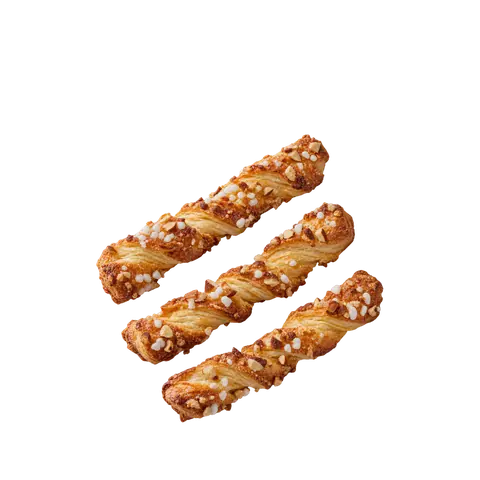
Twisted strips of puff pastry coated on both sides with pearl sugar and chopped almonds. A few minutes in the freezer firm the dough for cutting, and 15 more after twisting help the strips hold their shape.
- Makes
- 80 sacristains
- Total
- 536 g
- Butter
- 76% of the flour
- Layers
- 729 of butter, on paper
The layers
Puff pastry is laminated without yeast: a block of dry butter is sealed into a plain dough, then rolled and folded six times.
A dough of flour, water and a little soft butter is rolled to 24 × 12 cm, the dry butter to a 12 × 12 cm square. They should bend alike when they meet: butter that is too cold cracks, butter that is too warm smears into the dough.
The butter goes on one half of the dough and the other half folds over it. One layer of butter between two of dough.
Rolled out and folded in thirds, two folds at a time with an hour in the refrigerator between: 3, 9, 27, 81, 243 and then 729 layers of butter.
Rolled to 20 × 40 cm and 2.5 mm thick, each layer of butter is under a thousandth of a millimeter thick on paper. Layers that thin break and merge, one reason puff pastry stops at six folds.
Puff pastry has no yeast. All of its rise is steam from the water in the dough and the butter, lifting the layers while the butter keeps them apart.
Why two butters
- Butter in the USAt least 80% fat by law, about 17% water
- Butter in the doughFrench butter: 82% fat, about 16% water. 20 g here
- Dry butter for the layersAbout 84% fat, 14% water. 75 g here
Dry butter (beurre sec) has less water. It stays firm yet pliable when cold, so it rolls into one thin sheet instead of cracking or smearing into the dough, and it does not soften the dough it touches. In the US, use a European-style butter at 82% or more, or 84% laminating butter from a bakery supplier.
Classic puff pastry
| Ingredient | Grams | Baker’s % |
|---|---|---|
| 125 g | 100% | |
| 2.5 g | 2% | |
| 20 g | 16% | |
| 62.5 g | 50% | |
| 1 g | 0.8% | |
| 75 g | 60% | |
| Total | 286 g |
- Dissolve the salt and vinegar in the water.
- Add the flour and the softened butter and mix briefly with the dough hook.
- Roll the dough to a 24 × 12 cm rectangle and chill it.
- Roll the dry butter into a 12 × 12 cm square.
- Enclose the butter in the dough, give it two single (letter) folds, then refrigerate for 1 hour.
- Repeat the two folds and the hour in the refrigerator twice more, for 6 single folds in all.
- Refrigerate the dough for 12 hours.
Shaping and baking
| Ingredient | Grams | |
|---|---|---|
| 70 g | ||
| 30 g | ||
| 75 g | ||
| 75 g | ||
| Total | 250 g |
- Roll the dough to a 20 × 40 cm rectangle, 2.5 mm thick.
- Mix the pearl sugar with the chopped almonds.
- Brush the dough with the egg wash of yolks and milk and scatter half the sugar and almond mix over it.
- Press lightly with the rolling pin so the topping sticks well.
- Turn the dough over and do the same on the other side.
- Freeze for a few minutes.
- Cut the dough lengthwise into two 10 × 40 cm bands, then cut each band into 40 strips of 1 × 10 cm, 80 in all.
- Twist each strip and press its ends down firmly to flatten them.
- Freeze for 15 minutes.
- Bake for about 15 minutes at 180 °C (350 °F).
For bakers in the US
- All-purpose flour (T65)
- French type 65 flour; in the US, an unbleached all-purpose flour
- Laminating butter (84% fat)
- Laminating or sheet butter, about 84% fat
- Pearl sugar
- Coarse sugar nibs that do not melt in the oven (Belgian or Swedish pearl sugar)
